
Client
Internal product
Case study
InspectGogh turns a public website into a conversation people can inspect: the score matters, but the evidence, methodology, and processing state are what make the result trustworthy.
Client
Internal product
Role
Product architecture, evidence-backed reporting, processing reliability
Year
2026
Summary
Built a website inspection product that ties marketing observations to evidence, presents transparent scoring, and processes Report 2.0 jobs durably.
Website reviews are often presented as a score without enough explanation to make the score useful. A customer may want to know whether a site is clear, findable, credible, or ready to support a campaign, but a number by itself does not explain what to change or whether the underlying observation is grounded in the page being reviewed.
InspectGogh was built around a more defensible flow. Inspect a live public website, evaluate it through a defined set of marketing lenses, attach observations to evidence, and make the result understandable to the customer who has to decide what to do next. The product has to be useful as both an internal analysis tool and a customer-facing report.
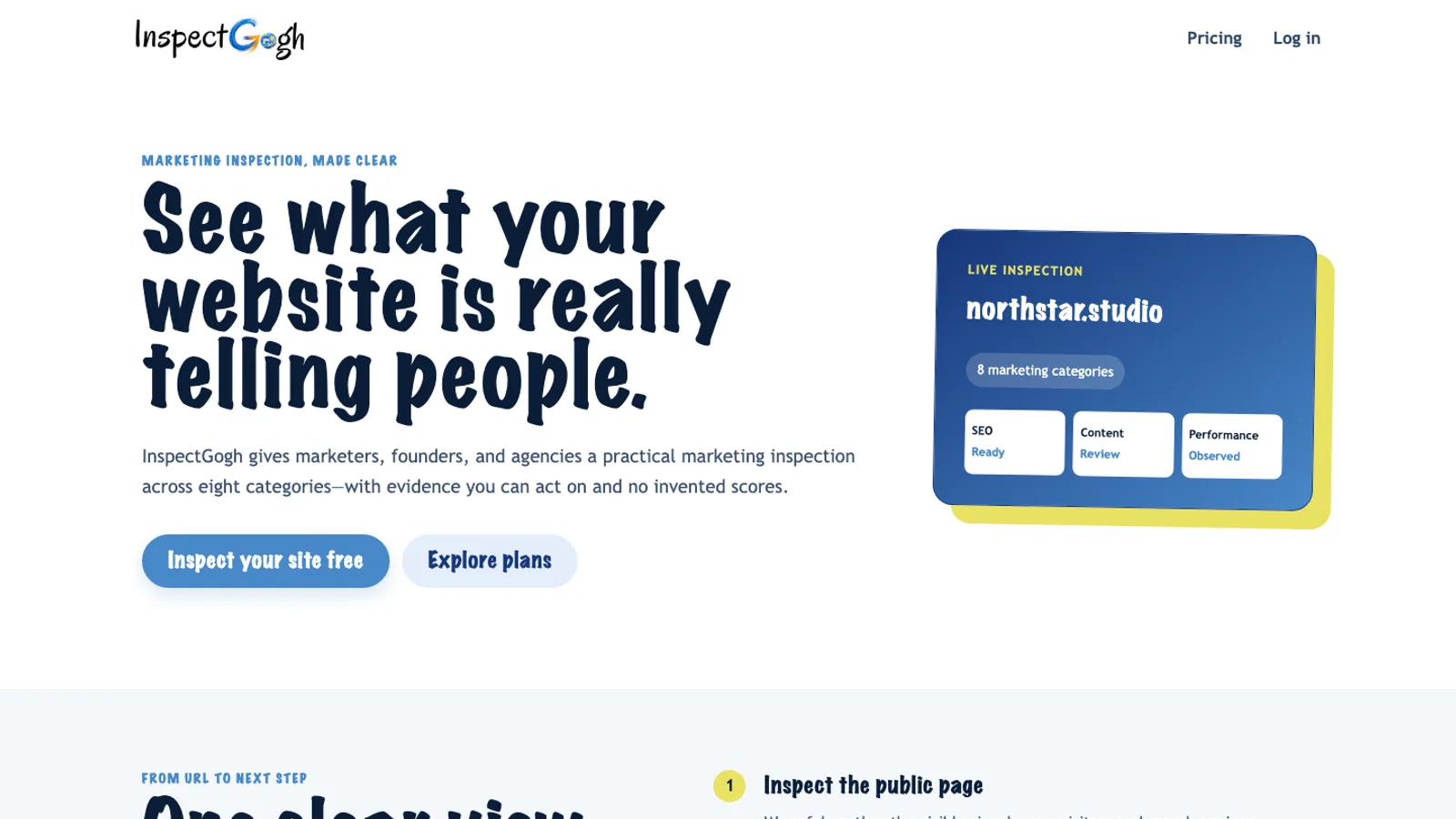
The public product surface frames the work as an evidence-led inspection of a live marketing site.
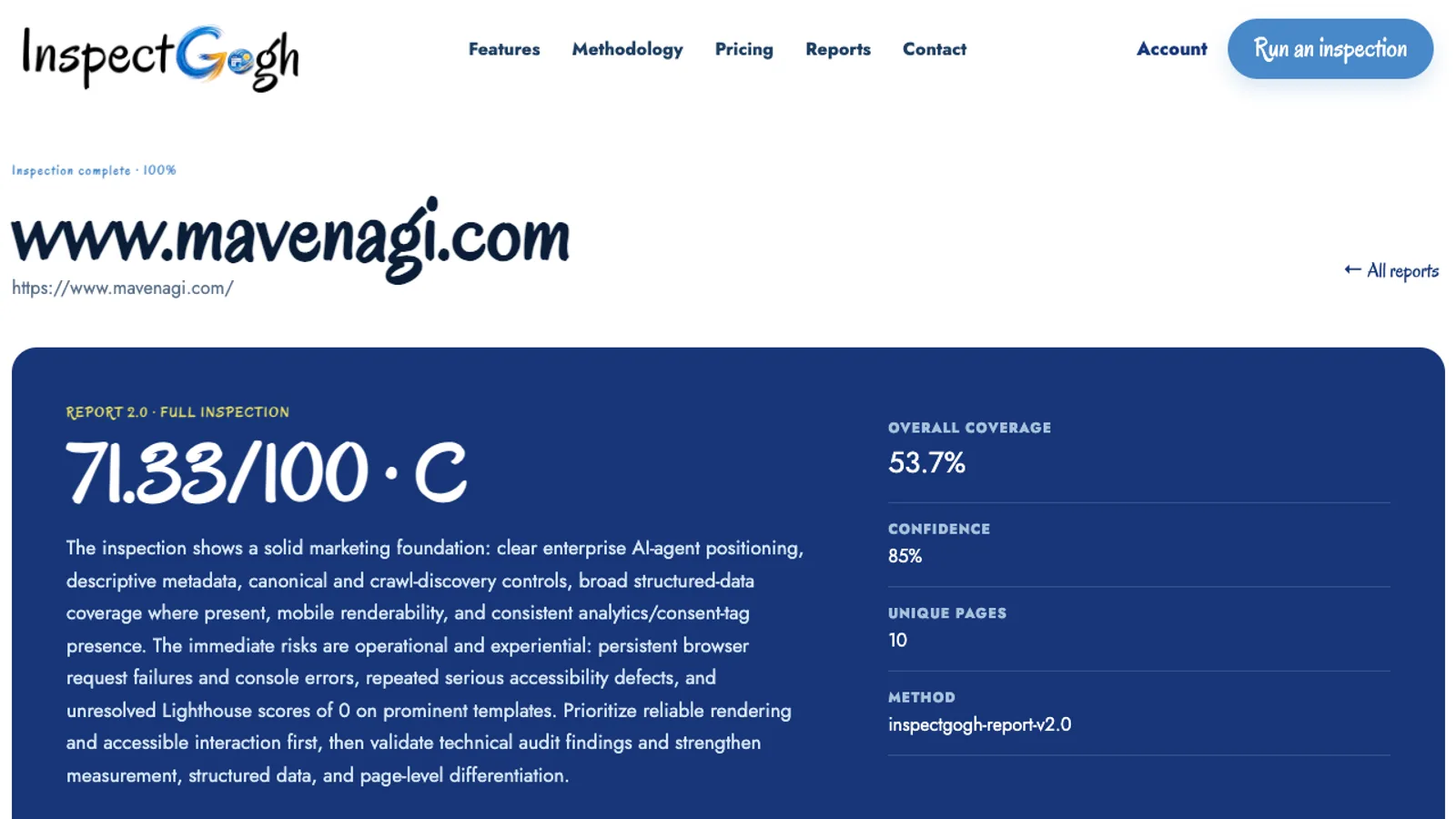
The completed report surface makes category findings and supporting material visible instead of hiding the result behind one score.
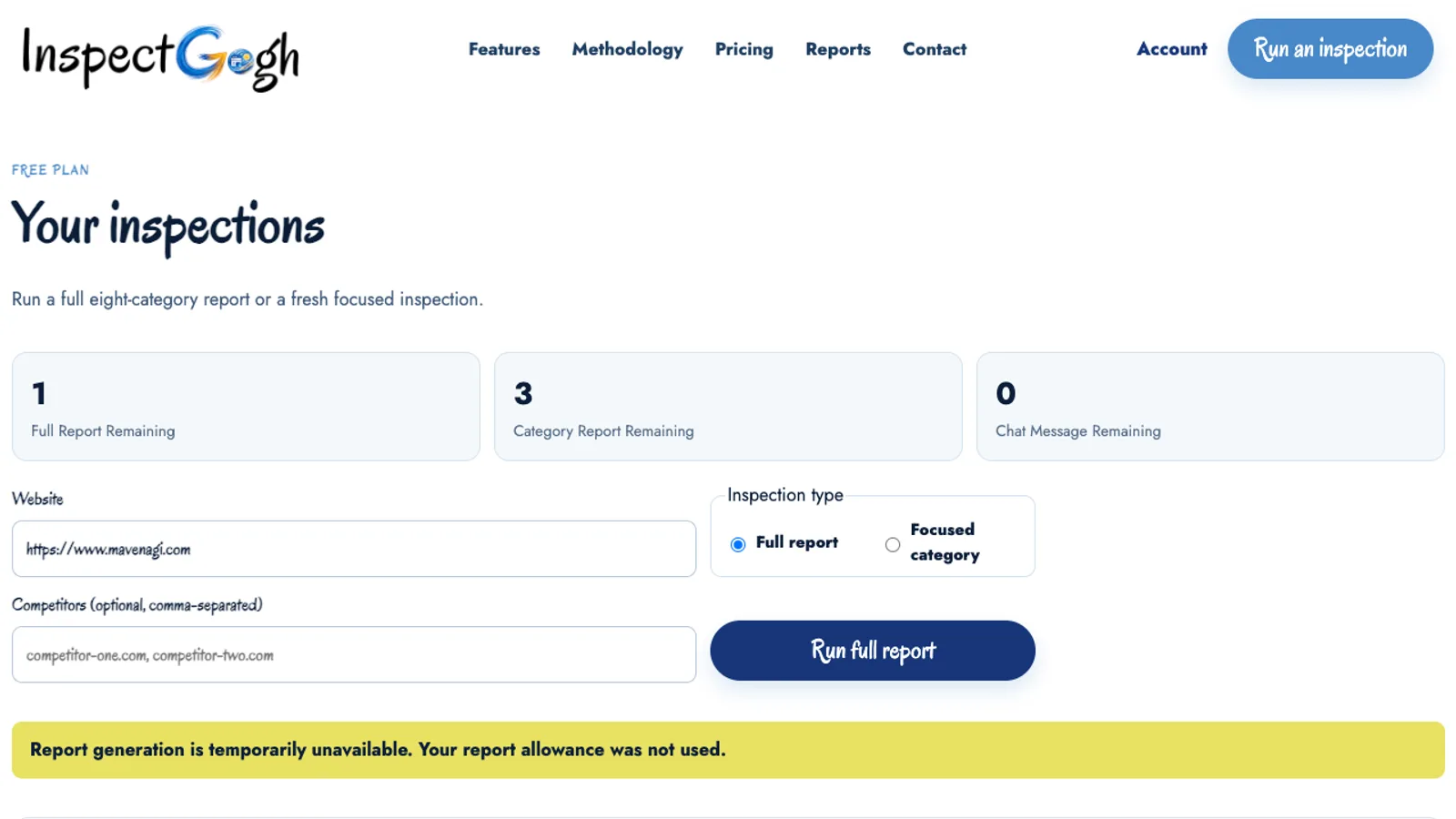
The application communicates when a full report is still processing or temporarily unavailable, without pretending a partial result is complete.
The inspection model uses eight marketing lenses to give the review a repeatable shape. The lenses are useful because they create a shared vocabulary for a conversation, but the vocabulary alone is not enough. Each observation needs a relationship to the public evidence that produced it: a page element, a source, an omission, or a visible path that another person can inspect.
That changes the tone of the report. Instead of saying that a site “feels weak,” the product can show which category is affected, what it observed, and why the observation matters. A customer can challenge a finding with the evidence in front of them, or turn the finding into a concrete next action. Transparent scoring is not a claim that the model is perfectly objective; it is a commitment to make the path from input to conclusion visible enough to evaluate.
The report is not a single request that either succeeds or disappears. Report 2.0 processing is represented as a durable job with readiness and checkpoint behavior. The application can tell the difference between a completed report, a report still being processed, a focused category result, and a temporary unavailability state. That distinction protects both the customer experience and the usage model.
Durability matters because website inspection crosses multiple slow or fallible steps: fetching public pages, extracting signals, evaluating categories, and assembling a customer-facing result. If a process is only held in one request, a timeout turns into ambiguity. A job record and checkpoints give the worker a place to resume and the UI a truthful status to display.
The product also keeps its operational boundary visible. A report that is not ready should say so. A focused category can remain useful without being mislabeled as the full report. An unavailable result should not silently consume a customer’s allowance and should not be presented as a complete score. Those states are small details with a large effect on trust.
Customer-facing methodology is part of the product, not an appendix written after the UI. A report has to explain what the categories mean, what kind of evidence is considered, and how a reader should interpret a score. That gives the customer a way to move from a result to a conversation about priorities.
The methodology also creates a feedback loop for the product itself. When a customer questions an observation, the team can ask whether the evidence was incomplete, the category definition was unclear, or the scoring behavior needs improvement. The inspection becomes a system for learning what makes a marketing review useful, not merely a report generator.
InspectGogh makes an inspection more credible by connecting four surfaces: a defined lens model, source-backed observations, durable report processing, and a customer-readable methodology. The result is not just a grade. It is a structured conversation about a live website, with enough evidence and status transparency for the customer to understand what happened and decide what happens next.
Related writing
If an AI feature can change a customer decision, an operator workflow, or a safety boundary, its evaluation plan is part of the product requirement.
Launches go better when teams instrument critical workflow states, delays, failures, and human intervention before go-live.
Operational simplicity lets teams publish, recover, and change systems without constant escalation or hidden process drag.
Relevant services
Applied AI that improves delivery, diagnostics, reporting, and internal tooling without turning the stack into a science experiment.
Builds and refactors for the parts of a platform that determine whether launches stay fast, reliable, and maintainable.